Reduce DSO and improve cash flow for UK small businesses
Reduce DSO and improve cash flow for UK small businesses

Days sales outstanding (DSO) is the average number of days a business takes to collect payment after completing a sale. For UK small businesses, a high DSO is not merely an accounting inconvenience. It is a direct constraint on payroll confidence, supplier payments, and growth investment. Reducing DSO from 60 to 45 days in a business with £2.4 million annual revenue unlocks nearly £100,000 in working capital without a single new financing arrangement. The strategies to reduce DSO fall into four clear categories: invoice accuracy, collection cadence, credit term management, and accounts receivable automation. Each one is measurable, and each one compounds the others.
What do you need in place to reduce DSO effectively?
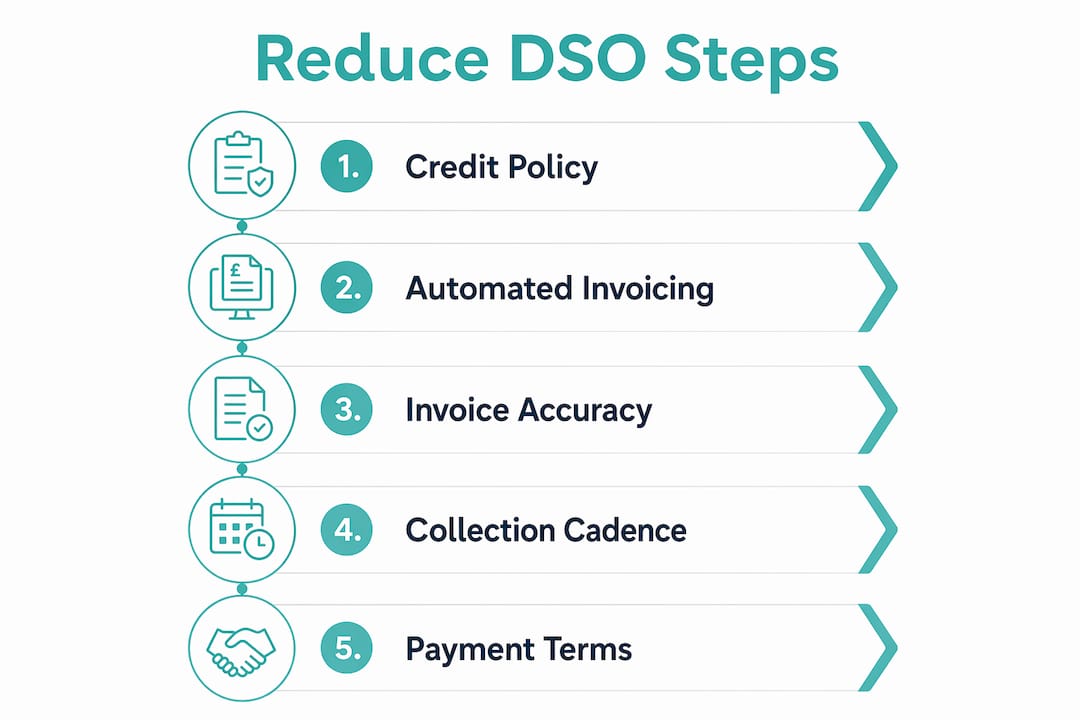
The foundation of any DSO improvement programme is a documented credit and collections policy. Without one, your team makes inconsistent decisions about who gets credit, on what terms, and when to escalate. The policy does not need to be lengthy. It needs to define credit limits by customer tier, standard payment terms, escalation triggers, and who owns each stage of the collections process.
Automated invoicing tools sit directly on top of that policy. They dispatch invoices the moment a sale completes, apply the correct payment terms, and trigger reminder sequences without manual intervention. The gap between top and median companies in DSO performance is roughly 18 days, and the primary differentiator is this kind of routine accounts receivable (AR) automation. That 18-day gap represents real money sitting in your debtors’ ledger instead of your bank account.

Accurate data capture is equally non-negotiable. Every invoice must carry the correct purchase order number, the right billing contact, and the agreed payment terms. A single missing field gives a customer a legitimate reason to delay payment. Integrating your AR process with your existing accounting software, whether that is Xero, QuickBooks, or Sage, removes the manual re-keying that introduces those errors in the first place.
| Feature category | What it does for DSO |
|---|---|
| Automated invoice dispatch | Eliminates batching delays; invoices reach clients immediately |
| Scheduled reminder sequences | Maintains consistent follow-up without manual effort |
| Payment link integration | Reduces friction at the point of payment |
| Dispute flagging | Separates contested invoices from clean collections queue |
| AR and accounting sync | Prevents data errors that cause payment holds |
How does invoice accuracy shorten receivable days?
Invoice errors guarantee disputes, and disputes cause payment pauses that can add weeks to your DSO. Accurate invoicing prevents delays more reliably than any amount of chasing after the fact. This is the upstream fix that most small businesses overlook because they are too focused on the downstream problem of overdue accounts.
The most common invoice errors in UK small businesses include:
- Wrong or missing purchase order number
- Incorrect VAT rate or VAT number
- Billing contact name that does not match the client’s accounts payable system
- Mismatched payment terms versus the original contract
- Missing bank details or incorrect sort code and account number
Invoicing immediately upon delivery reduces DSO by 5–8 days by narrowing the window between work completed and payment demanded. That figure alone justifies switching from monthly billing runs to same-day or next-day invoice dispatch. Monthly batching is a habit inherited from paper-based processes. It has no place in a business that needs cash to flow predictably.
Pro Tip: Set up automated pre-issue validation in your invoicing tool to check for missing PO numbers, incorrect VAT codes, and mismatched payment terms before the invoice leaves your system. Catching errors at dispatch costs seconds. Resolving a dispute costs days.
What collection cadences best reduce days sales outstanding?
Consistency in collections cadence matters more than tone or urgency. A rigid, automated reminder schedule changes customer payment behaviour more reliably than sporadic manual calls, however firmly worded. Customers learn when to expect contact, and that predictability alone accelerates payment.
A proven cadence for UK small businesses runs as follows:
- T-7 days before due date. Send a friendly pre-due reminder confirming the invoice amount, due date, and payment method. This prevents administrative holds caused by lost invoices or forgotten approvals.
- T-1 day before due date. Send a brief confirmation prompt. Many payments stall at the approval stage inside a client’s finance team. A day-prior nudge clears that queue.
- Due date. Send a same-day reminder if payment has not been received. Keep the tone calm and factual.
- T+3 days overdue. Escalate to a firmer written notice. Reference the original payment terms and, where applicable, your right to claim statutory interest under the Late Payment of Commercial Debts (Interest) Act 1998.
- T+14 days overdue. Add a phone call to the sequence. Phone calls at 14 or more days overdue increase collection rates by a further 25%.
Starting reminders before the invoice due date prevents the most common cause of late payment: the invoice that simply fell through the cracks of a busy client’s inbox. Most late payments are not wilful. They are administrative. Your cadence should treat them as such until the evidence says otherwise.
Pro Tip: Personalise the sender name on automated emails so they appear to come from your account manager rather than a generic billing address. Response rates improve noticeably, and the relationship stays intact.
Dispute detection belongs inside the cadence, not outside it. When a client responds to a reminder with a query or a rejection, that invoice moves immediately to a separate resolution queue. Keeping disputed invoices in the standard chase sequence wastes effort and irritates clients. Resolving disputes fast is itself a DSO improvement technique.
How do credit terms and incentives shorten receivable days?
Payment terms are a pricing lever, not a passive default. Most UK small businesses set Net 30 because that is what they have always done. The more effective approach is to align terms with each customer’s creditworthiness and your own cash flow requirements.
Setting payment terms strategically, such as Net 15 for newer clients or requiring a deposit for weaker credit profiles, prevents you from unknowingly financing your clients’ operations. Extending generous credit to every customer regardless of payment history is a structural cause of high DSO that no reminder sequence can fully correct.
Early payment discounts work when the maths supports them. An early payment discount of 2% net 10 costs 2% of the invoice value but can yield over 36% annualised return on the working capital freed. For a business with tight cash flow, that trade-off is straightforward. Offer the discount selectively to clients who represent your largest outstanding balances.
Key principles for managing credit terms to lower DSO:
- Review credit limits at least annually, or after any significant change in a client’s payment behaviour
- Shorten terms for clients who consistently pay late rather than simply chasing them harder
- Automate flags when a client approaches or exceeds their credit limit
- Require prepayment or a deposit from new clients until a payment track record is established
- Document every agreed variation to standard terms so disputes cannot arise from ambiguity
Enforcing terms consistently is as important as setting them correctly. Inconsistent enforcement signals to clients that your terms are negotiable, which extends DSO across the entire portfolio.
What role does automation play in sustaining DSO improvements?
Automation is the mechanism that makes every other DSO improvement technique sustainable. Manual collections processes fail under volume and during busy periods. Automated AI collections action 100% of overdue invoices within 24 hours, compared to 30–40% for manual teams. That coverage gap is where DSO slippage happens.
AI-driven reminder automation can reduce DSO by 15–25 days within 60 days by maintaining consistent follow-up that manual teams miss. That is not a marginal improvement. For a business billing £1 million annually, 20 fewer days in DSO releases roughly £55,000 in cash.
The practical benefits of AR automation for small businesses include:
- Invoice dispatch triggered automatically at the point of sale
- Reminder sequences that run without human initiation
- Payment matching that reconciles receipts against open invoices in real time
- Dispute flags that route contested invoices to a separate queue immediately
- Cash flow reporting that shows DSO trends over time
The shift automation enables is equally important. When routine reminders run themselves, your time moves to high-value exceptions: the large overdue account that needs a personal call, the client in financial difficulty that needs a payment plan, the dispute that requires a credit note. Top-performing firms focus human effort on automated cash application and dispute resolution, not on sending the same reminder email for the fourth time.
Arrevox is built specifically for this shift. It combines automated email reminders with integrated payment links, adjustable communication tone, and cash flow analysis, giving UK small businesses the coverage of an enterprise AR team without the overhead.
Key takeaways
Reducing DSO requires consistent financial hygiene across invoicing, credit management, and collections, not just harder chasing of overdue accounts.
| Point | Details |
|---|---|
| Invoice accuracy first | Errors cause disputes that add weeks to DSO; fix upstream before chasing downstream. |
| Start reminders before the due date | A T-7 and T-1 day cadence prevents administrative payment holds before they occur. |
| Align credit terms to risk | Shorten terms for weaker payers and offer early payment discounts to accelerate cash. |
| Automate for full coverage | Automated AR actions 100% of overdue invoices within 24 hours; manual teams reach 30–40%. |
| Measure DSO regularly | Tracking DSO trends over time reveals which clients and processes need attention first. |
Why most DSO advice misses the point
The standard advice on reducing DSO focuses almost entirely on collections: send more reminders, call earlier, be firmer. That advice is not wrong, but it treats the symptom rather than the cause. In my experience working with small businesses on cash flow management, the businesses with the worst DSO problems share one characteristic. They are chasing inaccurate invoices.
A disputed invoice does not just pause payment on that one account. It consumes time, damages the client relationship, and often results in a credit note that resets the clock entirely. The businesses that reduce DSO sustainably are the ones that invest in getting the invoice right before it leaves the building. Automation helps enormously here, but the discipline has to come first.
The other mistake I see repeatedly is treating credit terms as a formality. Businesses extend Net 30 or Net 60 to every client because they fear losing the work. What they are actually doing is providing an interest-free loan to clients who may not deserve it. Reviewing credit limits annually and shortening terms for slow payers is not aggressive. It is sound financial management.
Cash flow is not vanity. It is survival. The businesses that treat DSO as a metric worth measuring and improving, rather than a background frustration, are the ones that grow with confidence rather than anxiety.
— Sean
How Arrevox helps UK small businesses collect faster
Small businesses that implement the strategies in this article often find the hardest part is consistency. Sending reminders at exactly the right time, every time, for every invoice, is simply not realistic without automation.
Arrevox is built for UK small businesses that want the discipline of a professional AR process without hiring a collections team. It sends automated email reminders with integrated payment links, lets you adjust the tone from a polite pre-due nudge to a firm final notice, and gives you cash flow analysis that shows exactly which invoices are putting pressure on your working capital. It connects with your existing accounting software so setup is straightforward. If reducing your days sales outstanding is the goal, Arrevox provides the consistent, relationship-preserving process to get there.
FAQ
What is a good DSO for a UK small business?
A DSO below 30 days is considered strong for most UK small businesses. The gap between top and median performers is roughly 18 days, so consistent improvement is achievable without radical process changes.
How quickly can you reduce DSO after making changes?
AI-driven AR automation can reduce DSO by 15–25 days within 60 days when applied consistently. Invoice accuracy improvements and earlier reminder cadences produce results within the first billing cycle.
Does offering early payment discounts actually improve cash flow?
A 2% net 10 discount costs 2% of the invoice value but can yield over 36% annualised return on freed working capital. For businesses with tight cash flow, the trade-off is strongly positive when applied to large or slow-paying accounts.
What is the Late Payment of Commercial Debts Act?
The Late Payment of Commercial Debts (Interest) Act 1998 entitles UK businesses to claim statutory interest on overdue B2B invoices. Referencing this right in escalation notices often prompts faster payment without requiring legal action.
Should you chase every overdue invoice the same way?
No. Disputed invoices should move to a separate resolution queue immediately. Applying a standard reminder sequence to a contested invoice wastes effort and damages the client relationship. Resolve the dispute first, then restart the collections cadence.