

Small business cash flow: your 2026 UK guide
Small business cash flow: your 2026 UK guide

Small business cash flow is defined as the net movement of money into and out of your business over a given period. It is not profit. A business can show a healthy profit on paper and still run out of cash to pay wages, rent, or suppliers. 82% of small business failures are linked to poor cash flow management or a misunderstanding of how cash actually moves. That figure is not a warning. It is a fact about survival. For UK small business owners and freelancers, understanding and actively managing cash flow is the single most important financial discipline you can build.
What is small business cash flow and why does it matter?
Cash flow is not vanity. It is survival. Your bank balance tells you what you have right now. Your cash flow tells you what you will have next week, next month, and in three months’ time. Those are very different things, and confusing them is where most cash crises begin.
Profit is an accounting concept. It records revenue when it is earned and expenses when they are incurred, regardless of when money actually changes hands. Cash flow records only real money movements. You can invoice a client for £5,000 in January and not receive payment until March. Your profit figure looks fine. Your cash position does not.

Cash flow determines business survival month to month, independent of profitability. A freelancer with a full order book but 60-day payment terms can still miss payroll. A retailer with strong seasonal sales can still struggle to pay suppliers in a quiet quarter. Recognising this distinction is the foundation of every sound cash management decision.
How do you read a cash flow statement?
A cash flow statement has three sections: operating activities, investing activities, and financing activities. Each tells a different part of the story.
- Operating activities show cash generated or used by your core business. This includes receipts from customers, payments to suppliers, wages, and tax. It is the most important section for day-to-day liquidity.
- Investing activities cover cash spent on or received from assets. Buying equipment, selling a vehicle, or purchasing software licences all appear here.
- Financing activities record borrowing, loan repayments, and owner drawings. A business drawing heavily on credit to fund operations will show this here.
The critical distinction from profit-and-loss accounting is timing. Accrual accounting records a sale when the invoice is raised. A cash flow statement records it only when the money arrives. This gap, driven by Accounts Receivable and Accounts Payable, is where liquidity problems hide.
A common mistake is treating a rising bank balance as proof of good cash health. It may simply mean a large payment arrived this week that will not repeat next month. Reading the statement properly means tracking the trend across all three sections, not just the closing balance. Accounts Receivable outstanding for more than 30 days is a direct drain on operating cash, even if it never appears as a loss.
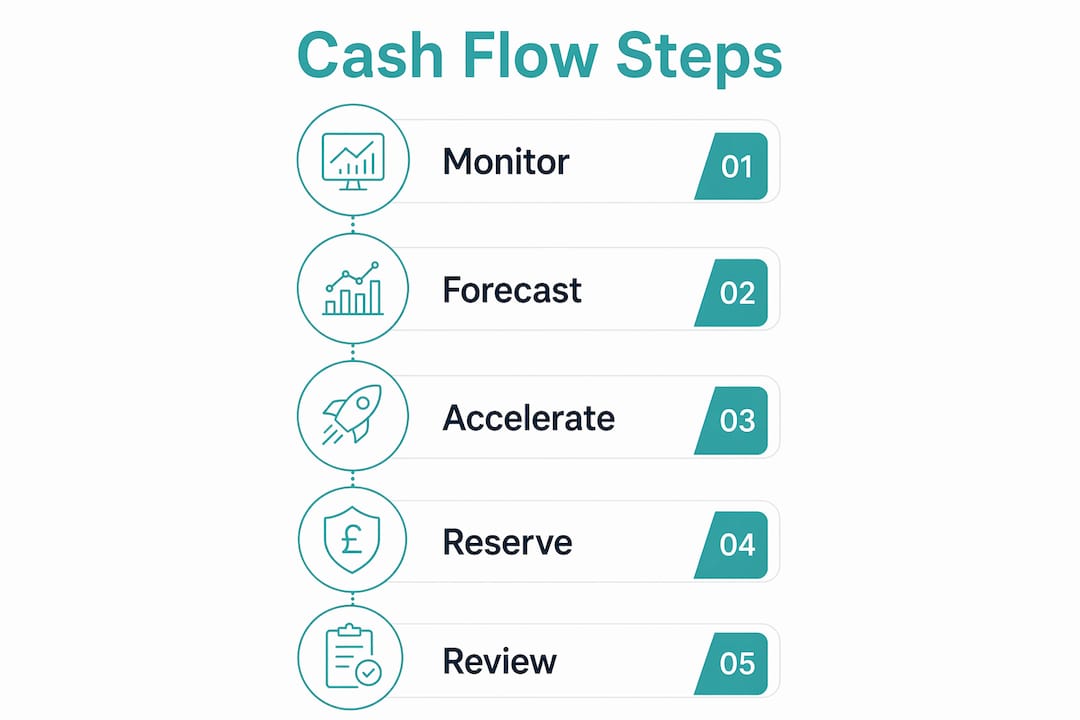
Practical strategies to improve cash flow and accelerate payments
Reducing Days Sales Outstanding (DSO), the average number of days it takes to collect payment after invoicing, is the most effective lever to improve available cash immediately. Every day you shorten your collection cycle is a day less you are funding your client’s operations with your own money.
- Shorten your payment terms. Move from 30-day to 14-day terms where your client relationships allow. Many clients will accept shorter terms if you ask. Most business owners never do.
- Invoice immediately. Send the invoice the moment work is delivered or a milestone is reached. Delays in invoicing directly delay payment. A week’s delay in sending an invoice is a week added to your DSO.
- Offer early payment incentives. A 2% discount for payment within seven days costs less than the interest on a credit facility and often costs less than the time spent chasing.
- Automate your follow-up. Systematic reminders and escalation reduce DSO and improve cash velocity. A reminder sent three days before the due date, on the due date, and at seven days overdue is far more effective than a single chaser sent at 30 days.
- Negotiate supplier terms outward. Ask suppliers for 45 or 60-day terms while collecting from clients in 14 days. The gap between inflows and outflows is your working capital. Widening it costs nothing if you negotiate well.
- Review your client mix. Chronic late payers cost more than their invoices are worth. Identify them using your Accounts Receivable ageing report and consider whether the relationship is worth the cash strain.
Pro Tip: Billing is not an administrative task. Treat it as a strategic lever and your receivables management becomes a competitive advantage. Businesses that bill promptly, follow up systematically, and escalate calmly collect faster and retain better client relationships than those that chase awkwardly and late.
How do you build a 13-week rolling cash flow forecast?
The 13-week rolling cash flow forecast is the most practical planning tool available to a small business owner. Thirteen weeks covers one full business quarter. It is close enough to be accurate and far enough ahead to act on what you see.
Weekly 13-week forecasting gives you operational clarity and removes the reactive panic that comes from discovering a cash shortfall three days before payroll. The forecast does not need to be complex. It needs to be honest and updated every week.
What to include in your forecast
- Opening bank balance for the current week
- Expected receipts: invoices due, recurring client payments, any other confirmed inflows
- Fixed outflows: rent, payroll, loan repayments, subscriptions, and insurance
- Variable outflows: supplier payments, materials, contractor fees
- Closing balance: the net position after all movements
| Week | Opening balance | Expected receipts | Total outflows | Closing balance |
|---|---|---|---|---|
| 1 | £8,200 | £4,500 | £5,100 | £7,600 |
| 2 | £7,600 | £2,000 | £3,800 | £5,800 |
| 3 | £5,800 | £6,000 | £4,200 | £7,600 |
| 4 | £7,600 | £1,500 | £5,500 | £3,600 |
Week 4 in this example signals a potential problem. Spotting it three weeks in advance gives you time to chase an outstanding invoice, delay a discretionary purchase, or draw on a credit facility before the shortfall becomes a crisis.
Acting early on forecast signals by accelerating receipts, delaying non-critical spend, or adding cash extends your runway significantly. Waiting until the shortfall arrives removes all your options.
Pro Tip: Set aside 30 minutes every Monday morning to update your forecast with last week’s actuals and revise the next 13 weeks. Weekly cash flow reviews at this cadence are the single habit that separates businesses that manage cash from those that react to it.
Managing cash reserves and financing options for UK small businesses
A cash reserve is not idle money. It is the buffer between a bad month and a crisis. A reserve equal to 8 weeks of fixed operating expenses is a sound starting point for most businesses. Seasonal businesses or those with long payment cycles may need 12 to 16 weeks.
Your bank balance does not reflect your true cash position. Fixed obligations, including rent, payroll, and loan repayments, are due regardless of whether clients have paid. Knowing your minimum cash floor, the point below which you cannot meet obligations, is the first step in setting a reserve target.
When it comes to small business financing options, the right tool depends on the gap you are filling:
- Business overdraft or line of credit: useful for short-term timing mismatches. Not suitable for funding ongoing losses.
- Invoice factoring or discounting: converts outstanding invoices into immediate cash. Effective for businesses with long payment cycles and creditworthy clients.
- Asset finance: spreads the cost of equipment purchases without depleting cash reserves.
- Government-backed loans: schemes such as the British Business Bank’s Start Up Loans programme offer structured funding for eligible businesses.
Borrowing to cover operational losses is a warning sign, not a solution. Financing works best when it bridges a timing gap between confirmed income and current obligations. Your 13-week forecast is the document that makes these conversations with lenders credible and specific.
What are the most common cash flow problems for UK small businesses?
Cash flow problems in small businesses follow recognisable patterns. Spotting them early is far less costly than managing them in crisis.
“37% of CFOs report their financial data is unreliable, leading to poor cash flow decisions and operational instability. For small businesses without a dedicated finance team, the risk is even higher.”
Unreliable data is the root cause of most avoidable cash crises. If your invoicing records, bank reconciliation, and Accounts Receivable ageing report are not accurate and current, every decision you make is based on guesswork.
Workflow bottlenecks and operational inefficiencies cause a 20–30% loss of top-line revenue annually in scaling businesses. That loss flows directly through to cash. Slow internal processes, delayed invoicing, and poor handoffs between delivery and billing all reduce the cash that reaches your account.
Other common warning signs include:
- Repeatedly using a credit facility to cover routine expenses
- Paying suppliers late because client payments have not arrived
- Avoiding looking at your bank balance before making a purchase
- Seasonal dips that catch you unprepared every year despite being predictable
- Profit growing while cash feels permanently tight
Each of these signals a specific problem with a specific fix. Seasonal dips require a reserve built during strong periods. Tight cash despite growing profit usually means DSO is too high or payment terms are too generous. Repeated credit use for operations means outflows exceed inflows structurally, and the business model needs review.
Key takeaways
Effective cash flow management for small businesses requires weekly discipline, accurate data, and a proactive approach to receivables, not reactive responses to crises.
| Point | Details |
|---|---|
| Cash flow is not profit | A profitable business can still fail if cash does not arrive when obligations are due. |
| Reduce DSO immediately | Shortening the time between invoicing and payment is the fastest way to free up working capital. |
| Use a 13-week forecast | Update it weekly to spot shortfalls early and act before options run out. |
| Set a cash reserve | Hold at least 8 weeks of fixed operating expenses as a minimum buffer against disruption. |
| Automate payment follow-up | Systematic reminders sent before and after the due date collect faster than manual chasing. |
Cash flow is a discipline, not a dashboard
I have worked with enough small business owners to know that the ones who sleep well are not the ones with the highest turnover. They are the ones who know their cash position on any given Monday morning without having to log in and check.
The uncomfortable truth about cash flow management is that most of the problems I see are not caused by bad business. They are caused by good business done without a rhythm. A freelancer who wins a large contract, delivers excellent work, and then waits 60 days to be paid while their own bills arrive on time is not running a bad business. They are running a good business badly administered.
The 13-week forecast is not a finance director’s tool. It is a one-page spreadsheet that any business owner can maintain in half an hour a week. The businesses I have seen transform their cash position fastest are the ones that started there, not with complex accounting software or external advisors.
Billing strategically rather than administratively is the other shift that changes everything. Sending an invoice is not the end of the process. It is the beginning of a collection process that should be calm, systematic, and persistent. Businesses that treat it that way collect faster, argue less, and retain better client relationships.
Cash flow is not a vanity metric. It is the measure of whether your business can operate tomorrow. Build the habit before you need it.
— Sean
How Arrevox supports better cash flow for UK businesses
Overdue invoices are the most common and most controllable cause of cash flow pressure for UK small businesses and freelancers.
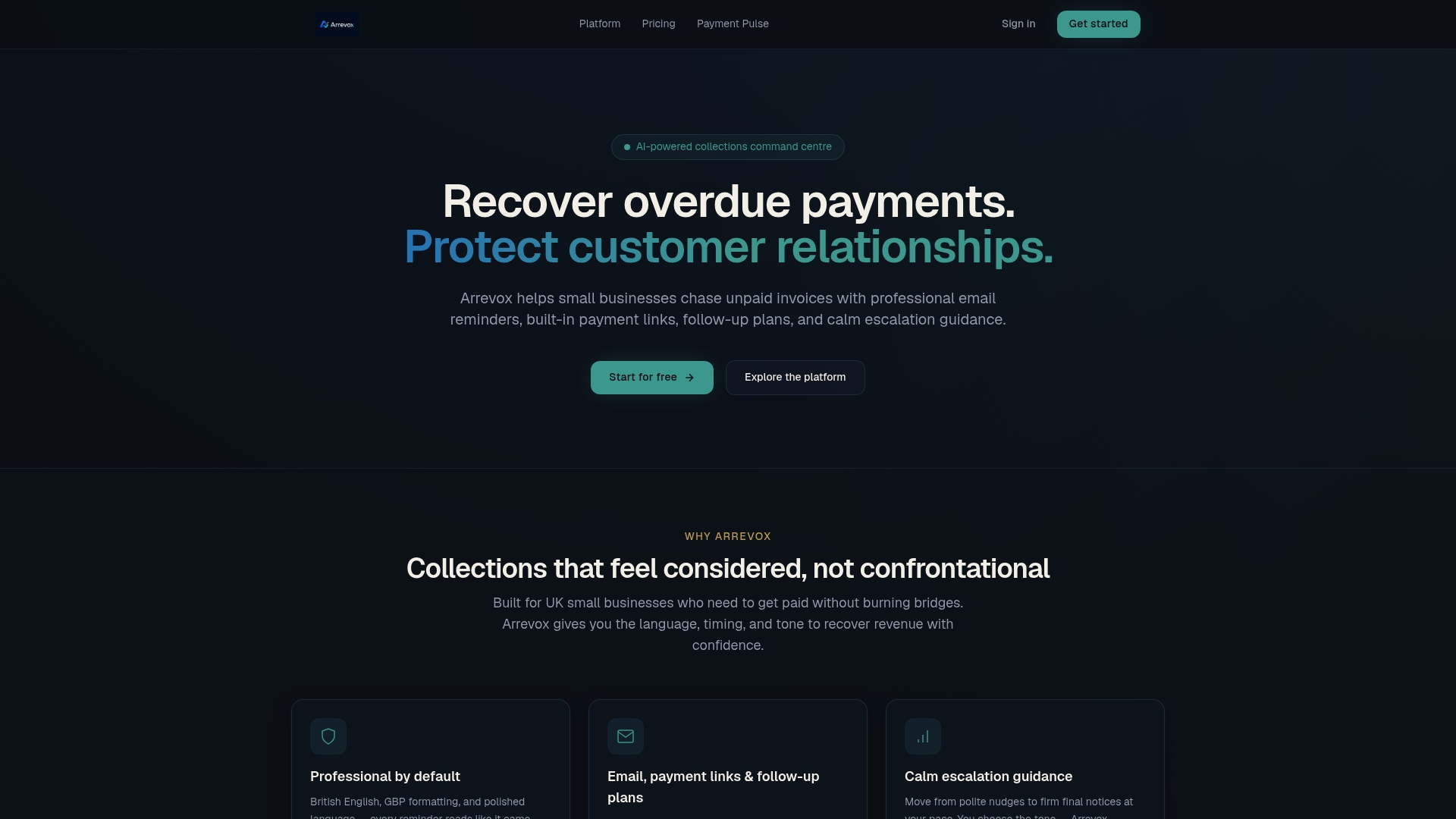
Arrevox is built specifically to address this. The AI Collections Command Centre automates professional payment reminders with integrated payment links, so you collect faster without the awkward manual chasing. You choose the tone, from a friendly pre-due nudge to a firm final notice, and Arrevox handles the timing and escalation. The platform also provides cash flow analysis based on your invoice data, so you can see the real impact of overdue payments on your position. Less time chasing. More cash arriving. Stronger client relationships maintained throughout.
FAQ
What is the difference between cash flow and profit?
Profit records revenue and expenses when they are earned or incurred. Cash flow records only actual money movements. A business can be profitable but cash-poor if clients pay late.
How do I improve cash flow quickly?
Reducing Days Sales Outstanding by invoicing immediately and following up systematically is the fastest lever. Offering early payment discounts and tightening payment terms also accelerate inflows without requiring external financing.
What is a 13-week cash flow forecast?
A 13-week rolling forecast tracks expected cash inflows and outflows week by week for the next quarter. Updated weekly with actuals, it gives you enough advance notice to act on shortfalls before they become crises.
How much cash reserve should a small business hold?
A reserve equal to 8 weeks of fixed operating expenses is a practical starting point for most businesses. Seasonal businesses or those with long payment cycles should target 12 to 16 weeks.
Why do small businesses fail due to cash flow problems?
82% of small business failures are linked to cash flow mismanagement, often because owners confuse profit with cash availability or fail to forecast and act on shortfalls early enough.